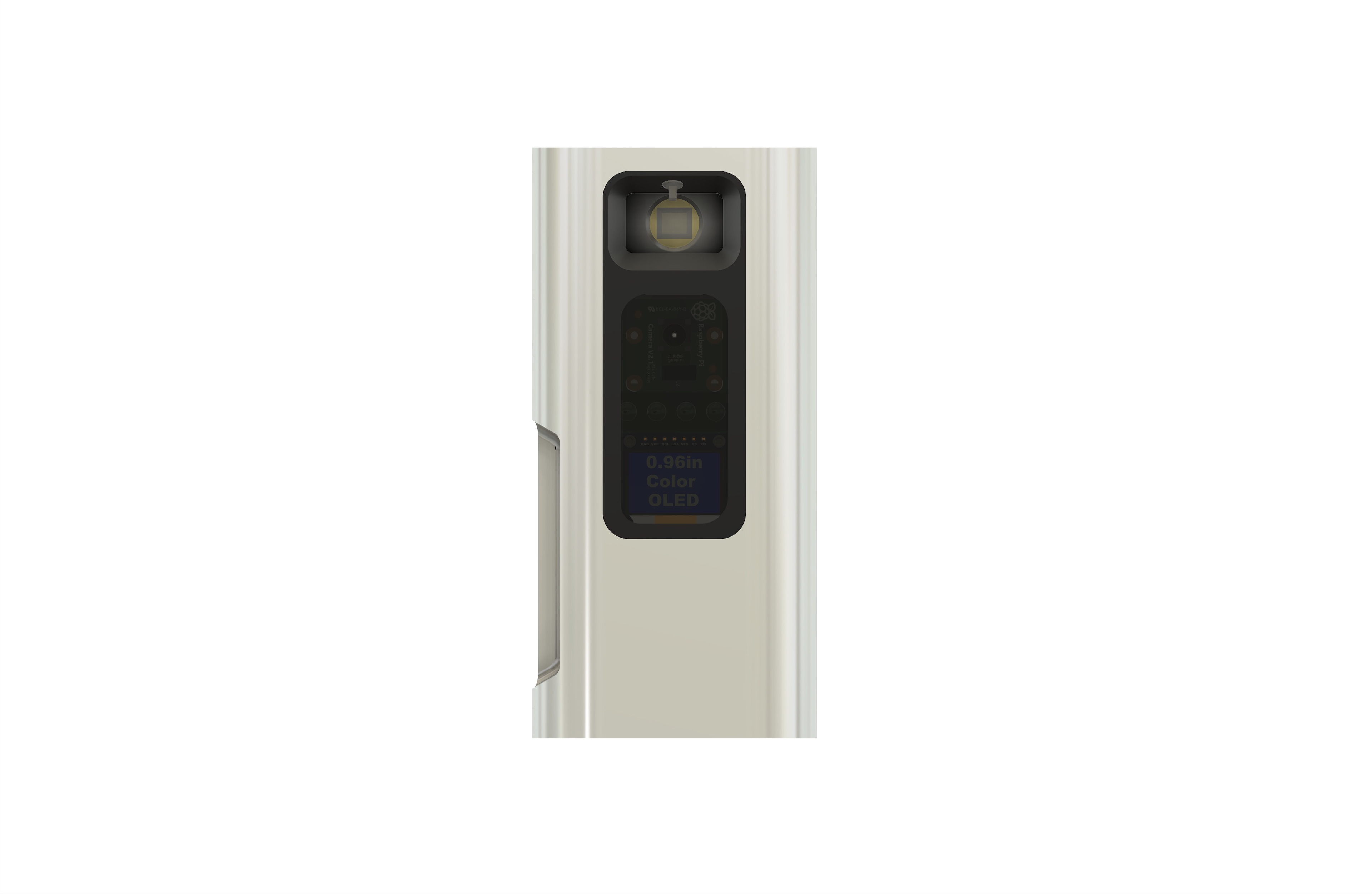
ROLES: Product Design Engineer
Project Origin:
Epilog AI provided me with an AI-generated concept sketch that hinted at the futuristic industrial design they envisioned. The existing prototype — while functional — was oversized, component-heavy, and not optimized for manufacturability.
My mission was to convert that vision into a practical, engineering-accurate device that:
•remains faithful to the concept aesthetic,
•supports advanced AI and sensor hardware,
•and can be reliably CNC machined from aluminum
•supports advanced AI and sensor hardware,
•and can be reliably CNC machined from aluminum
Internal System Re-Architecture:
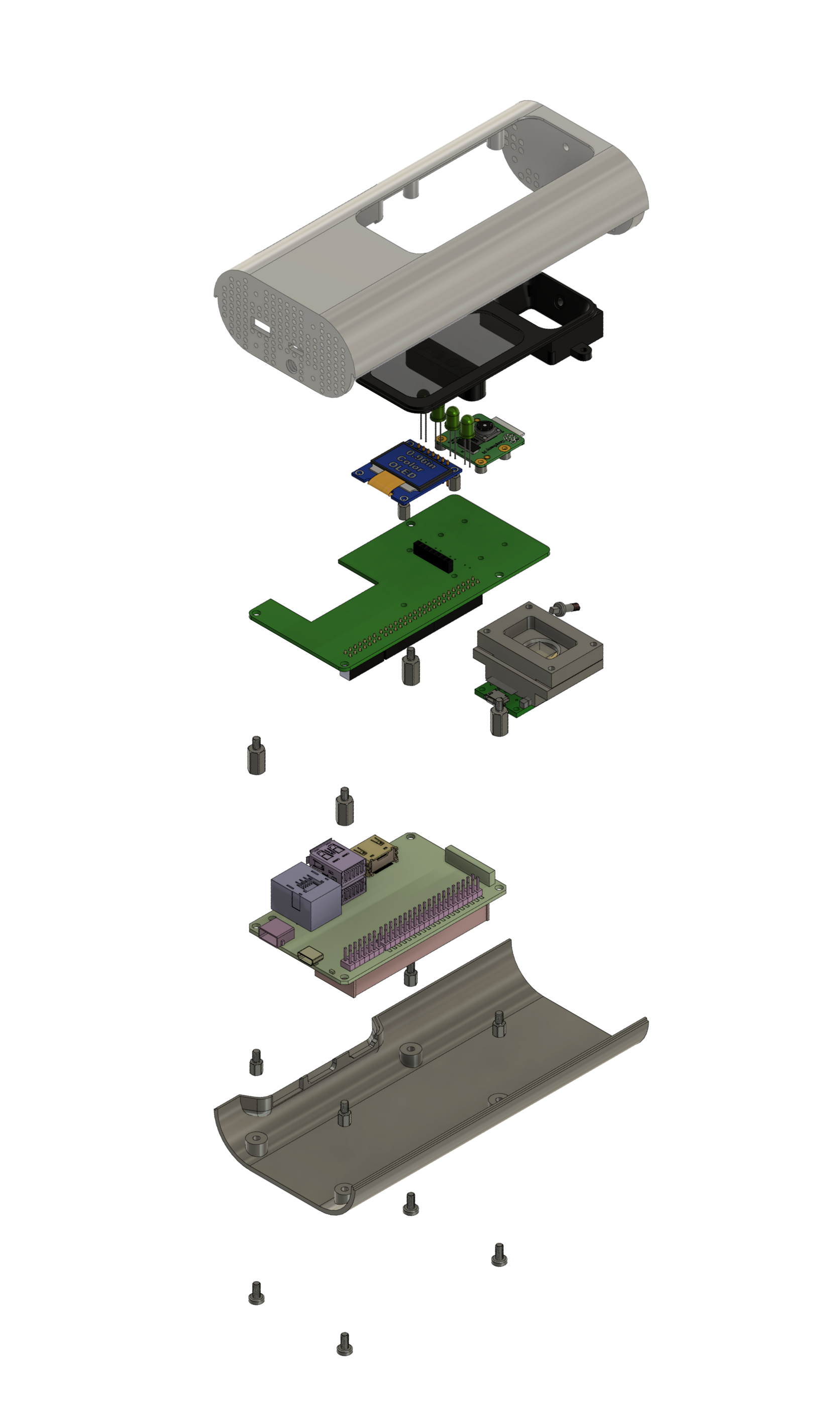
The original assembly included a collection of powerful components:
•NVIDIA Jetson Xavier NX with A203 carrier board
•Thermal sensor + copper temperature probe
•Raspberry Pi camera module
•0.95" full-color OLED screen
•Four IR LEDs in an optically isolated casing
•Multiple cables, mounting hardware, and interconnects
•Thermal sensor + copper temperature probe
•Raspberry Pi camera module
•0.95" full-color OLED screen
•Four IR LEDs in an optically isolated casing
•Multiple cables, mounting hardware, and interconnects
The initial challenge was clear: the earlier version was far too large for commercial use. My work began with reconstructing all components inside Fusion 360 using STEP files and existing models. From here, the mechanical puzzle began — I needed to compress, reorganize, and structurally integrate every part into a single cohesive body.
A custom mechanical breakout-shield PCB became the internal backbone. Although I didn’t design the circuitry, I engineered the PCB’s physical geometry to perfectly position and anchor the camera, OLED, and IR LEDs while aligning all connectors with the internal layout.
Engineering Challenges:
Epilog’s target was a device with 2–3× smaller dimensions than the original prototype. Achieving this required:
•A maximum total thickness of just 35 mm
•Zero interference with optical or thermal sensing paths
•Clean and accessible external ports
•A visually refined design matching investor-ready quality
•CNC machinability in aluminum without compromising structure
•Zero interference with optical or thermal sensing paths
•Clean and accessible external ports
•A visually refined design matching investor-ready quality
•CNC machinability in aluminum without compromising structure
This demanded a highly iterative workflow. After completing two visual concept explorations, I conducted five rounds of mechanical refinement, addressing everything from internal mounting to wall thicknesses, heat clearance, cable paths, and assembly order.
Prototyping and Validation
Before committing the design to CNC aluminum manufacturing, I produced multiple SLA-printed prototypes.
These were essential to validate:
•tolerances and fit
•sensor alignment
•port access and ergonomics
•assembly sequence
•rigidity and load distribution
•sensor alignment
•port access and ergonomics
•assembly sequence
•rigidity and load distribution
This ensured that once metal machining began, the final product would assemble smoothly and reliably. tolerances and fit
sensor alignment
port access and ergonomics
assembly sequence
rigidity and load distribution
sensor alignment
port access and ergonomics
assembly sequence
rigidity and load distribution
Final Outcome:
The final design delivered to Epilog AI was a dramatically miniaturized, structurally solid, production-ready device that preserved all sensing capabilities while achieving an elegant, modern aesthetic suitable for a venture-backed hardware company.
The device is now entering CNC machining, marking a major step in Epilog AI’s roadmap — and I’m proud to have played a critical role in shaping the physical identity of one of their key products.
Working with a venture-backed client at this scale underscored the importance of engineering precision, rapid iteration, and a deep understanding of both design and manufacturability — all of which shaped the success of this project.